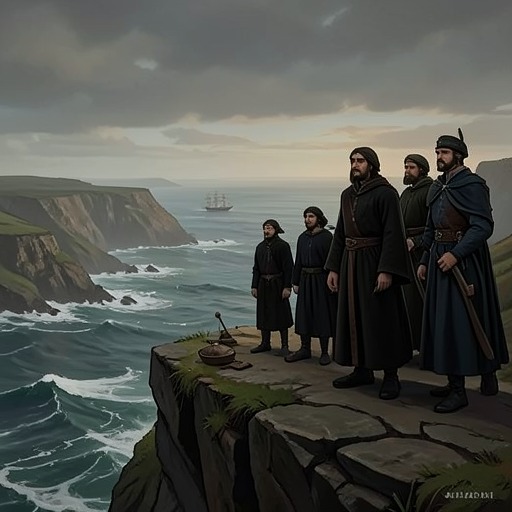
Irish Rebellion of 1534–1535
Wolf HallThe Irish Rebellion of 1534–1535 is presented as a crisis of English rule and state capacity: a revolt that the Crown cannot ignore, though Ireland brings little revenue and the campaign is described as a debacle and a drain on money. The narrative sets the conflict within a wider contest over allegiance, military responsibility, and the limits of royal authority. Rather than centring on a single battlefield, it follows the rebellion through council disputes, administrative preparations, and its effects on those serving the Crown.
Background and Stakes
The rebellion breaks out after a summer of negotiations has secured a treaty with Scotland. Ireland, by contrast, is in revolt: only Dublin Castle and Waterford are said to remain for the king, while rebel lords offer their services and harbours to the Emperor’s forces. The possibility of foreign support makes the crisis more than a domestic disturbance. The king fears that an outside power could exploit the rebellion, even as the narrative stresses how expensive and difficult the territory is to hold.
Cromwell’s account of Ireland is shaped by the assumptions of English rule. He describes a place where English law is weakly respected, where local leaders are said to rely on force and feuding, and where the Crown’s revenue does not meet the cost of its garrisons. The text also sets English exactions beside Irish resistance: people are impoverished by imposts, seizures, forfeitures, and robbery, while English rule threatens the power and privileges of local lords. Its blunt observation that the Irish have reason not to want to become English gives the conflict a political dimension beyond the court’s language of loyalty and order.
The Council Dispute
The prospect of an Irish campaign divides the king’s advisers. Henry proposes sending the Duke of Norfolk, but Norfolk resists returning to Ireland after what he regards as futile months there. He jokes that he will go only if a bridge is built so he can return without getting his feet wet. In the council chamber, he argues with Cromwell, who watches rather than matching the duke’s ranting.
Cromwell proposes a different kind of intervention: sending Henry Fitzroy to Dublin as an apprentice king, making a public display and spending money to assert royal presence. Richard Williams suggests that Cromwell himself might go to Ireland, but Cromwell says his campaigning days are over. He instead urges Richard to concentrate on appearing in tournaments. The exchange distinguishes military service from political theatre: Cromwell’s proposal is not simply to fight, but to make the monarchy visible and consequential in Ireland.
Supplies and Administrative Response
The narrative makes the preparations concrete through a dispatch listing matériel for Ireland: brass cannon and iron shot, powder, bows and bowstrings, tools, horseshoes, and nails. The inventory places the rebellion within the daily work of administration, where policy depends on assembling weapons, transport, and equipment. Cromwell is also in contact with people in Florence about hiring one hundred arquebusiers for the campaign, on the expectation that they would be more useful than Englishmen in wooded or rocky terrain.
These preparations sit beside the government’s other expenses and obligations. The king’s accounts include an unpaid bill for a cradle made for a child who did not survive, while military planning demands further funds and supplies. The juxtaposition does not make the rebellion a mere budget entry: it shows how the Crown’s claims on Ireland depend on a stream of material commitments, even as Cromwell observes that the territory costs more to garrison than it pays back.
Consequences and Narrative Significance
The rebellion remains unresolved in the political world of the novel. The text reports that the campaign is a debacle and a money sink, and later notes that the sweating sickness has broken out among the king’s troops in Ireland. Thomas More hears news of the outbreak in the Tower and reflects that the disease can kill swiftly and leave survivors unfit to fight. Cromwell withholds from him the fuller news of the campaign’s failure and cost, making Ireland part of the information he manages even in conversation with a prisoner.
The crisis also clarifies Cromwell’s role in the court. He is not shown leading the expedition; he weighs the alternatives, argues with Norfolk, proposes a conspicuous royal presence, and organizes resources, including prospective foreign troops. Ireland thus tests the monarchy’s practical reach while revealing the political methods by which Cromwell tries to extend it. The revolt’s significance lies in that gap between ambition and execution: the king’s authority is asserted, but must be maintained through negotiation, costly supplies, uncertain allies, and a campaign the narrative characterizes as unsuccessful.